
Psychological Thriller Short Story
“The difference between a detective and a murderer is only a matter of timing.”
— Martin Crowe, The Orchard Confession
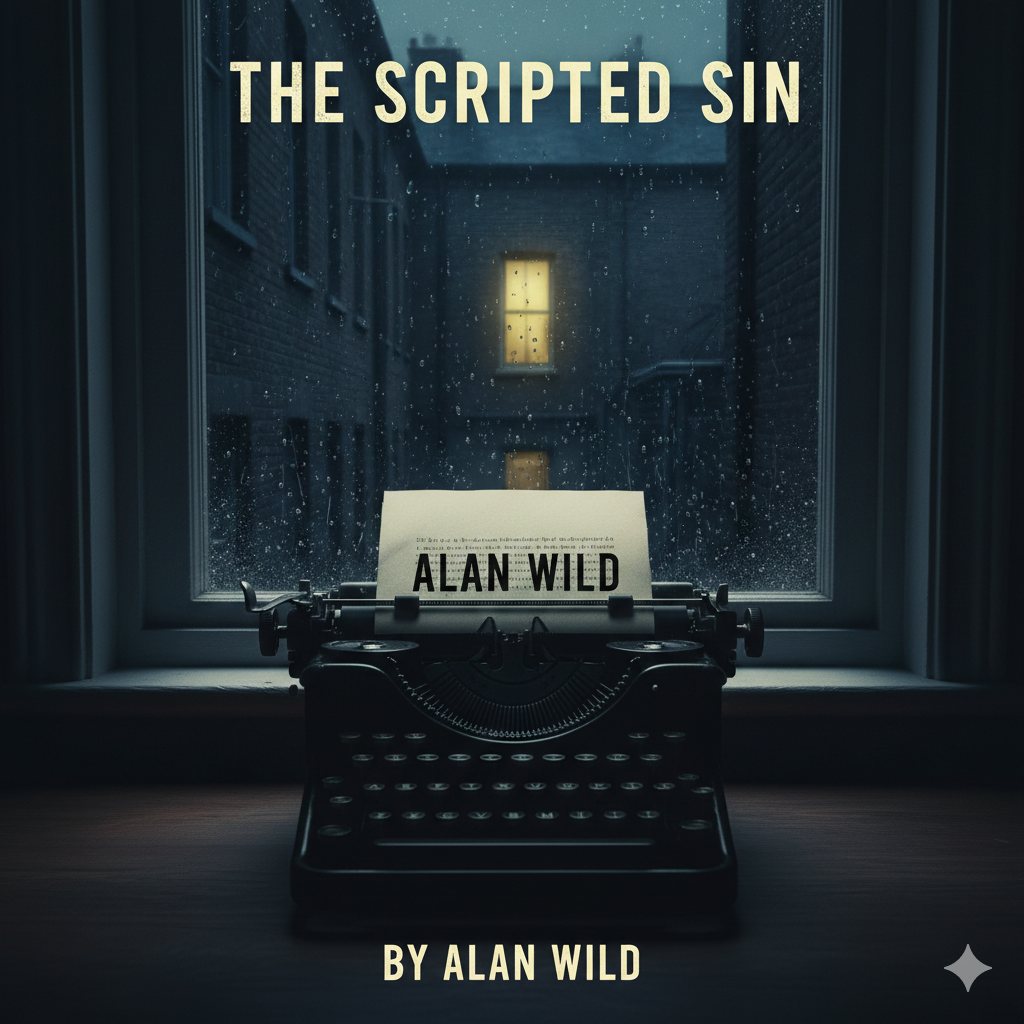
The envelope arrived on a Tuesday, slipped under the door of apartment 4B like all the others before it—utility bills, takeout menus, the occasional royalty statement thin enough to be an insult. But this one had no return address, no postage, just his pen name written in careful block letters: MARTIN CROWE.
Leonard Pryce hadn’t been Martin Crowe in three years. Not since The Orchard Confession sold its last modest print run, not since his editor stopped returning calls, not since the cursor on his laptop screen had become less a tool than a taunt—blinking, blinking, blinking against a white field as barren as his imagination.
He opened the envelope standing at the kitchen counter, next to a coffee mug ringed with yesterday’s residue. Inside was a single sheet of paper, typed on what appeared to be an actual typewriter. The letter “e” struck slightly higher than its companions, giving the text a faintly drunken quality.
Dear Mr. Crowe,
I am your greatest admirer. I have read The Orchard Confession eleven times. I know the way Inspector Ballard thinks—his methods, his instincts, his elegant cruelty. You understand something most writers don’t: that the difference between a detective and a murderer is only a matter of timing.
I am writing you a story. A real one. Watch the building across the courtyard. Third floor, second window from the left. The curtain is always drawn, but tonight it won’t be.
Your faithful reader.
Leonard read it twice. Then he poured the old coffee down the drain, made a fresh cup, and read it again. He told himself it was nonsense—some lonely eccentric who’d tracked down the man behind the pseudonym, who wanted to play a game. He told himself this even as he carried his chair to the window that evening and sat in the dark, watching the third-floor window of the building next door.
At 11:47 p.m., the curtain opened. A figure moved behind the glass, backlit by a lamp the color of weak tea. Then the light went out. That was all.
Leonard went to bed feeling foolish and oddly exhilarated. It was the first time in years he’d felt anything resembling suspense.
The second envelope arrived three days later. This one was thicker.
Chapter One, it said at the top. And below that, a narrative began—not addressed to him this time, but written in the style of a novel. His style. Or rather, Martin Crowe’s style, the clipped declarative sentences, the clinical attention to physical detail, the way violence was rendered not as spectacle but as procedure.
The chapter described a woman named Mrs. Adelstein who lived on the third floor of a building remarkably like the one across the courtyard. It described her habits: the way she watered her plants at six each morning, the way she left her door unlocked when she took out the recycling. It described the sound her neck made when it was broken—a sound compared, in a phrase Leonard recognized as one he himself had written in Chapter 9 of The Orchard Confession, to “the stem of a wine glass snapped between two fingers.”
Leonard set the pages down. His hands were not shaking, which surprised him. He walked to the window and looked at the third floor across the courtyard. The curtain was drawn again. He could see, at the building’s entrance below, a woman in a green coat carrying a bag of recyclables to the bin.
She was alive. Whoever Mrs. Adelstein was—if she was anyone—she was alive. This was fiction, he told himself. Disturbing fiction, uncomfortably close to his own voice, but fiction all the same.
He sat down at his laptop. For the first time in months, he began to type. Not the story from the envelope—something of his own, something sparked by the strange electricity of being read so carefully by someone who understood what he’d been trying to do. His fingers moved with an urgency he’d forgotten was possible.
He wrote until 3 a.m. and deleted everything the next morning. It wasn’t good. It was the ghost of something good, the memory of a muscle that had atrophied. But it had moved.
The chapters kept coming. One every three or four days, each slipped under the door in the small hours when the hallway was silent. Leonard began to wait for them the way he had once waited for reviews—with a mixture of dread and need that he recognized, even then, as unhealthy.
Chapter Two introduced a second character: a man called Dr. Paulson, who lived one floor below Mrs. Adelstein and who had, according to the narrative, been systematically poisoning her cat. The prose was meticulous. It described the specific compound used—something Leonard had to look up, and which turned out to be real, purchasable, and lethal to small animals in the doses described. It described the cat’s symptoms with the tenderness of someone who had watched them unfold.
Chapter Three was about a teenager in the building’s basement apartment who had been stealing mail for two years. The chapter listed specific items taken from specific mailboxes, including—and here Leonard’s stomach turned—a royalty check addressed to his own apartment, which he had assumed had been lost by the postal service six months ago.
That detail was too precise to be invented. Leonard stood at his window for an hour that evening, studying the building across the courtyard as though its brick face might rearrange itself into confession. He considered calling the police. He considered throwing the envelopes away. Instead, he filed them in a drawer and made a fresh pot of coffee.
He was hooked, and he knew it. The envelopes were doing what his own writing no longer could: they were making him feel that the world contained a pattern, a hidden architecture of cause and consequence that could be mapped if only you paid close enough attention. This was the engine of every detective novel ever written, and Leonard had been a mechanic of that engine for twenty years. To feel it operating on him, rather than through him, was intoxicating.
Chapter Six arrived on a rainy Thursday and described a murder.
Not Mrs. Adelstein’s. A man named Garza, the building’s superintendent, found in the utility room with his head resting in the open drum of an industrial washing machine. The cause of death was drowning, though the chapter noted, in a parenthetical aside that felt almost playful, that the thirteen fractures to his ribs suggested the drowning had been assisted.
The writing had changed. The earlier chapters had been competent imitations of Leonard’s style, but this one was better than imitation. It had a quality Leonard associated with his own best work—a calmness in the presence of horror that functioned not as detachment but as a kind of respect for the gravity of what was being described. Whoever was writing these pages had moved past mimicry into something that felt, disturbingly, like collaboration.
Leonard checked the news. He walked past the building next door and read the names on the buzzers. There was a Garza listed for the basement unit. He pressed it. No one answered.
He pressed it again the next day, and the next. On the fourth day, the name tag had been removed and replaced with a blank strip of paper.
That night, Leonard poured himself a whiskey—something he hadn’t done in a year, having promised his doctor and his ex-wife and himself—and sat in the dark by the window. He was frightened. Not of danger to himself, which still felt abstract, but of the possibility that he had been reading about real events for weeks and had done nothing because the reading was too good to interrupt.
He thought about Inspector Ballard, the detective he’d created for The Orchard Confession. Ballard’s defining trait was not brilliance but compulsion: he could not leave a narrative unfinished. It was what made him a great detective and a terrible human being. His wife left him. His partner requested a transfer. Ballard didn’t care. He needed to know how the story ended more than he needed to be loved.
Leonard had always thought of Ballard as an exaggeration, a useful fiction. Sitting in the dark with whiskey burning in his throat and a dead man’s buzzer still echoing in his memory, he wasn’t so sure.
The final envelope was different from the others. It was larger, padded, and it did not arrive under the door. He found it leaning against the wall in the hallway outside his apartment at 6 a.m. on a Sunday, as though someone had placed it there with care, the way you might leave flowers at a grave.
Inside was a manuscript. Not a chapter—a complete document, sixty-some pages, with a title page that read:
THE ORCHARD CONFESSION: THE FINAL CHAPTER
by Martin Crowe
The first fifty pages were a synthesis of everything that had come before—the chapters about Mrs. Adelstein, Dr. Paulson, the mail thief, Garza—woven together into a single narrative with the structural precision of a well-built clock. Reading it was like watching someone assemble a bomb: each component innocent on its own, devastating in combination.
The last ten pages were instructions.
They were addressed to him directly, not as Martin Crowe but as Leonard Pryce, and they were written in a different register—plain, urgent, stripped of literary affect. The writer explained that a man was going to die in the building across the courtyard. The writer provided the apartment number (3A), the time (between midnight and 2 a.m. tonight), and the method (strangulation, made to look self-inflicted). The writer explained that the police would never solve it without help. The writer told Leonard exactly where to find the body and what to tell the authorities when he called: that he had heard a disturbance, that he had gone to check, that he had found the door ajar.
You wanted to be Ballard, the instructions said. Here is your chance. This is the case that will matter. Find the body, tell the story, be the hero. You were always better at finding truth than inventing it.
Leonard read the instructions three times. He understood that he should call the police immediately. He understood that what he was holding was, at minimum, evidence of criminal conspiracy and, at maximum, a blueprint for murder written by the murderer himself. He understood all of this with the rational part of his mind, which was functioning perfectly well.
But there was another part—the part that had spent three years staring at a blank screen, the part that had once known how to make a reader’s heart accelerate with nothing but the arrangement of words on a page, the part that missed being Martin Crowe the way an amputee misses a hand—and that part was already reaching for his coat.
The building’s front door was unlocked, as the instructions had promised. The stairwell smelled of paint and boiled vegetables. Leonard climbed to the third floor with the careful tread of a man who has written many scenes of careful treading and now finds the reality less cinematic than expected. His knees ached. His breathing was loud in the concrete silence.
Apartment 3A. The door was ajar, as promised. He pushed it open with the back of his hand—a detail from Chapter 4 of The Orchard Confession, where Ballard avoids leaving fingerprints at a crime scene. He was aware of the absurdity even as he did it: a fiction writer applying fictional techniques to a situation that was, he was increasingly certain, not fictional at all.
The apartment was small and nearly empty. A desk, a chair, a typewriter—the old manual kind, an Olympia SM9 with a ribbon that looked freshly changed. A bookshelf holding a single book: The Orchard Confession, first edition, its spine cracked and pages swollen with rereading.
And on the floor beside the desk, a man.
He was young—thirty, maybe thirty-five—thin, with the pallid complexion of someone who spent most of his time indoors. His eyes were open. A length of cord was wound around his neck, but loosely, almost ceremonially, as though it had been placed there after the fact. The actual cause of death was not immediately apparent, but the stillness of his body was unmistakable. This was not a man who was going to start breathing again.
On the desk, next to the typewriter, was a note. It was handwritten—not typed—and Leonard recognized the handwriting before he recognized what the recognition meant.
It was his own.
He picked up the note with hands that were now, finally, shaking. It was written on the same stationery he kept in his desk drawer, the cream-colored linen paper his ex-wife had given him for a birthday he could no longer remember. The handwriting was not a forgery—he could tell, the way you can always tell your own hand, the specific pressure of the downstrokes, the characteristic stumble of his lowercase “k.”
The note was a confession. It was written in the voice of Inspector Ballard—not Ballard the character, but Ballard as he might speak if he were real and had committed a murder and wanted to explain, with his characteristic precision, exactly why. It described a writer driven mad by silence, by the atrophy of his gift, by the discovery that a young man in the building across the courtyard had been writing better versions of his own prose and sending them to him as a taunt. It described a confrontation. It described a strangulation. It described the particular sound.
Leonard read it twice, the way he had read the first envelope. Then he looked at the dead man’s face and understood, with the clarity of a final chapter that has been carefully constructed to make all preceding chapters retroactively inevitable, what had been done to him.
He searched the apartment. In the typewriter, still wound around the platen, was a half-finished page—the beginning of another chapter, this one describing Leonard Pryce entering an apartment and finding a body. It ended mid-sentence: Leonard looked at the dead man’s face and understood, with the clarity of a final
In the desk drawer, he found a manila folder. Inside were photocopies of everything he’d written in the past three years—not the published work, of which there was none, but the abandoned drafts, the 3 a.m. fragments, the deleted files somehow recovered and printed. Alongside these were careful analyses, handwritten in the same block letters as the envelopes, noting stylistic patterns, characteristic phrases, habitual punctuation. It was the work of a scholar—or a forger.
Beneath the folder was a receipt from the post office, dated that morning. A package had been mailed to the local police precinct, return address: Apartment 4B, Leonard Pryce. The description on the customs form read: Manuscript—The Orchard Confession: The Final Chapter.
Leonard sat down in the dead man’s chair. The typewriter hummed faintly, the way old machines do, holding the warmth of recent use. He thought about Inspector Ballard. He thought about the particular cruelty of being understood perfectly by someone who intended to destroy you—how the understanding was, in fact, the mechanism of destruction. The fan had not merely read his work. The fan had read him. Had mapped the architecture of his compulsions, the precise sequence of levers that would make Leonard Pryce walk into an apartment at 1 a.m. and pick up a confession written in his own hand.
He could call the police now. He could explain. He could show them the envelopes in his drawer, the chapters, the instructions. He could make his case. But he was a mystery writer, and he knew—had always known, had built his career on knowing—that the most convincing story is the simplest one. And the simplest story was already written, already mailed, already arriving at the precinct in a padded envelope with his name and address in the corner.
A famous writer, long past his prime, his career in ruins, discovers that an anonymous admirer has been producing work that surpasses his own. He confronts the young man. Things escalate. The writer, unraveling, does what his most famous character would do: he follows the logic of the narrative to its conclusion, and then he writes it down, because that is what writers do.
It was, Leonard had to admit, a better plot than anything he’d managed in years.
He sat in the dead man’s chair for a long time, listening to the typewriter hum. Then he stood, walked to the door, and descended the stairs. The stairwell still smelled of paint and boiled vegetables. Outside, the sky was beginning to lighten in the east, the particular gray of a city dawn that Leonard had described in six different novels and had never once gotten exactly right.
He crossed the courtyard to his own building. He climbed to the fourth floor. He sat down at his laptop and, for the first time in three years, began to write something he knew he would not delete.
He did not call the police.
He didn’t need to. They would be calling him.
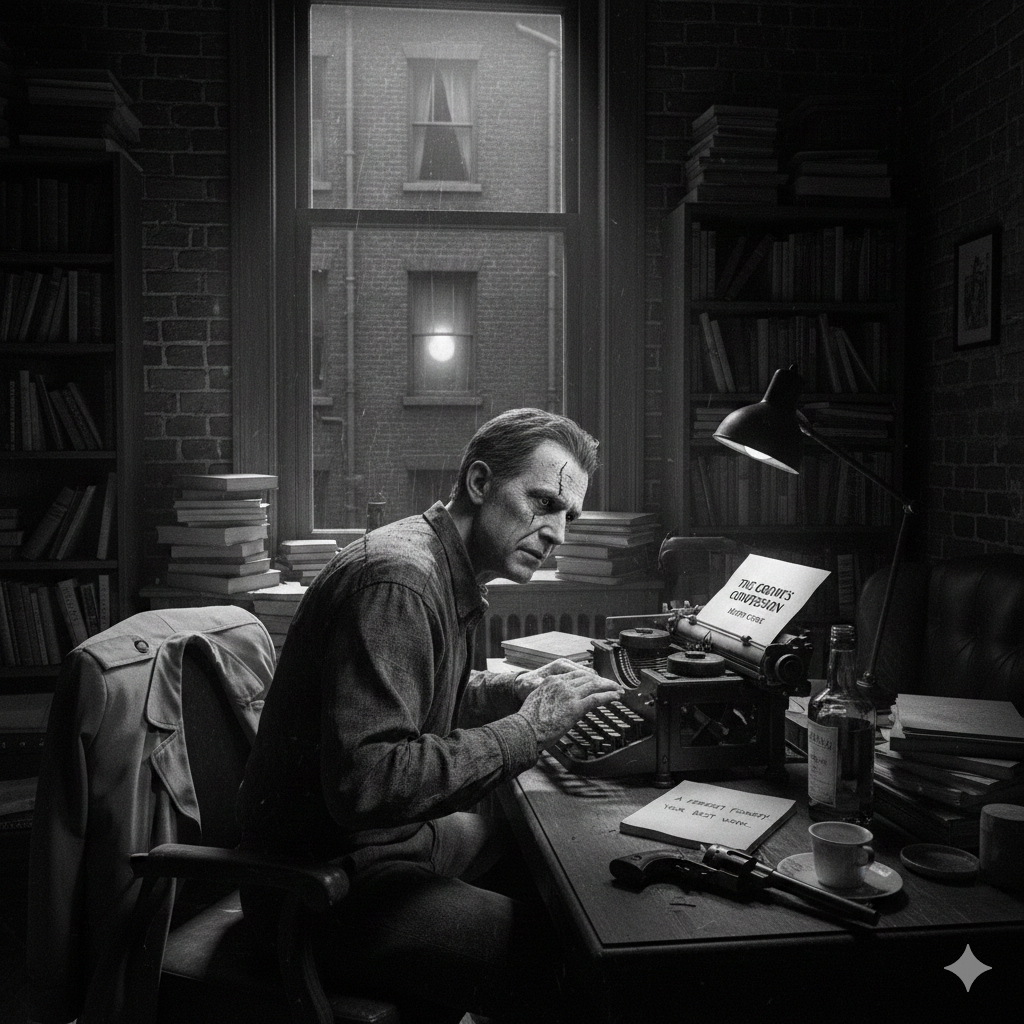
This Meta-fiction, Psychological Thriller Short Story written by Alan Wild